Many thanks to SWLing Post contributor and noted political cartoonist Carlos Latuff, who shares the following illustrated radio listening report.
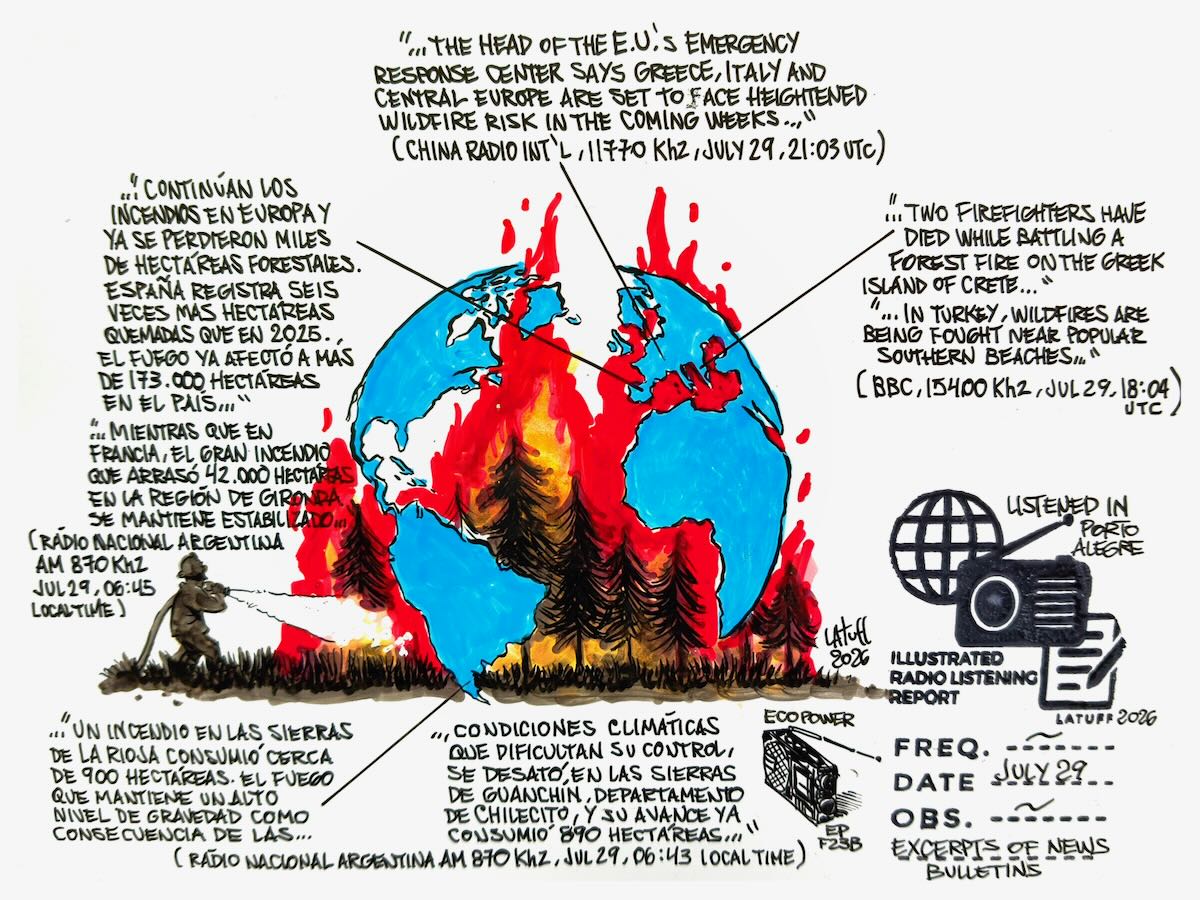
Carlos notes:
Wildfires, via Radio Nacional Argentina, BBC and China Radio International

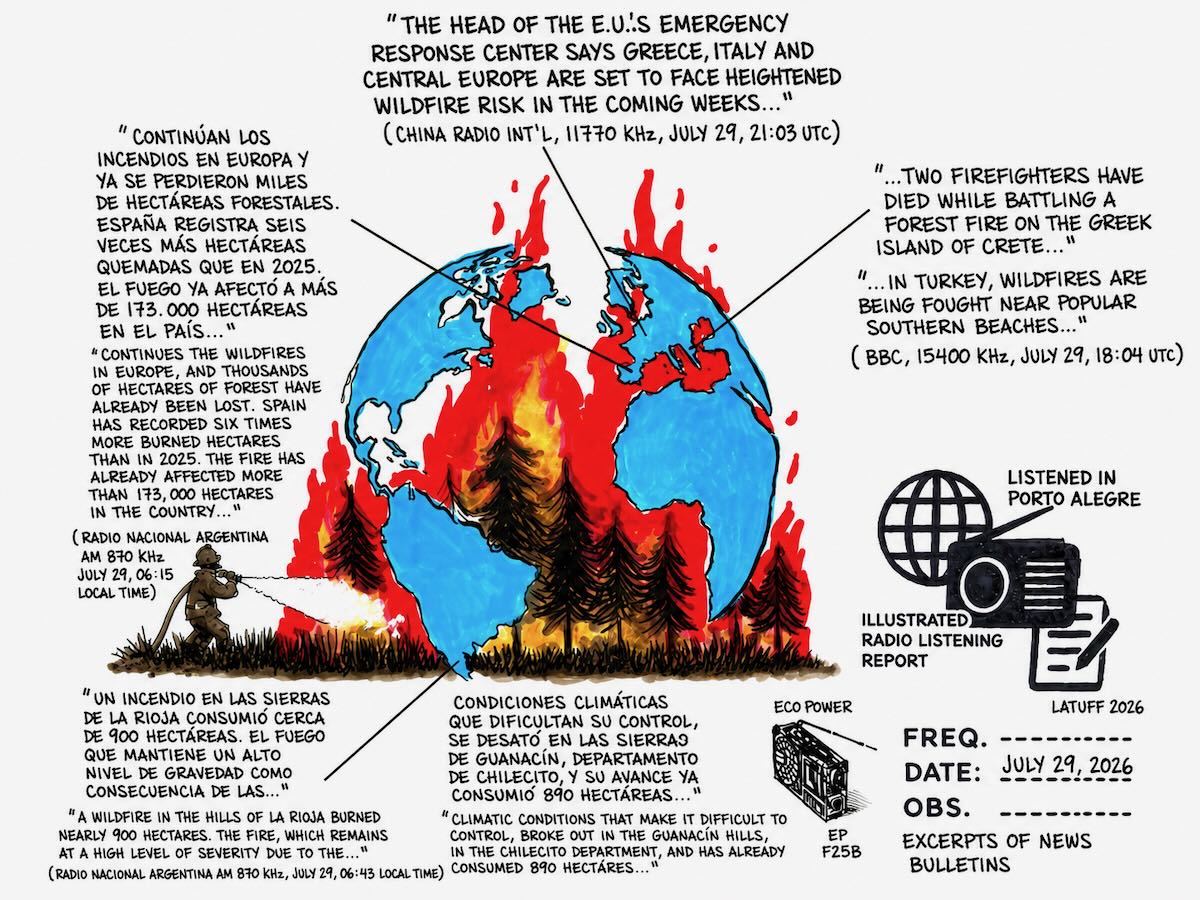
Many thanks to SWLing Post contributor and noted political cartoonist Carlos Latuff, who shares the following illustrated radio listening report.
Carlos notes:
Wildfires, via Radio Nacional Argentina, BBC and China Radio International
 Many thanks to SWLing Post contributor David Iurescia, who shares the following announcement noting that Radio Taiwan International’s French Service will once again broadcast directly from the Tamsui transmission site in northern Taiwan during August 2026. The special shortwave broadcasts are intended for listeners in Europe and North Africa and will air every Friday, Saturday, and Sunday from August 7–30, 2026.
The broadcasts details:
RTI notes that the second frequency has been changed from 11995 kHz to 11850 kHz after listeners reported persistent interference on 11995 kHz during the German Service’s July transmissions. The French Service also thanks listeners who helped verify the suitability of the new frequency.
Listeners who send reception reports to [email protected] will receive a special QSL card commemorating these August transmissions.
Below is the original announcement in French:
Chère auditrice, cher auditeur,
Le service français de Radio Taïwan International est heureux de vous rappeler que, durant le mois d’août 2026, nous procéderons à une diffusion directe depuis le centre de transmission de Tamsui, dans le nord de Taïwan, vers l’Europe et l’Afrique du Nord.
À cette occasion, notre programme en français sera diffusé en ondes courtes tous les vendredis, samedis et dimanches du 7 au 30 août. Voici les fréquences et les horaires de diffusion :
15145 kHz : de 17h00 à 17h30 (temps universel)
11850 kHz : de 17h30 à 18h00 (temps universel)
En raison d’un bruit parasite répétitif sur la fréquence 11995 kHz, signalé par nos auditeurs lors des diffusions du service allemand en juillet, le service français utilisera la fréquence 11850 kHz. Nous remercions tous les auditeurs qui nous ont aidés ces derniers jours à vérifier la possibilité d’utiliser cette fréquence.
Une carte QSL spéciale vous sera envoyée en confirmation de tout rapport d’écoute que vous pourrez nous adresser par courriel à l’adresse du service français de RTI : [email protected].
Merci de votre écoute et de votre fidélité.
Cordialement,
Le service français
RTI
Many thanks to SWLing Post contributor and noted political cartoonist Carlos Latuff, who shares the following illustrated radio listening report.
Carlos notes:
There’s no better place than AM and FM stations to get local news. I am a die-hard shortwave fan, but it’s on medium wave and frequency modulation that I stay informed about what is happening in my region. So, I decided to follow some news reports from radio stations based in Rio Grande do Sul as the state faces the onset of the El Niño phenomenon in 2026—an event experts had predicted.
The stations I listened to were:
These events unfolded just as the population of Rio Grande do Sul was still trying to recover from the trauma of the massive 2024 flood, which devastated numerous municipalities and inundated parts of the state capital, Porto Alegre, where I live.
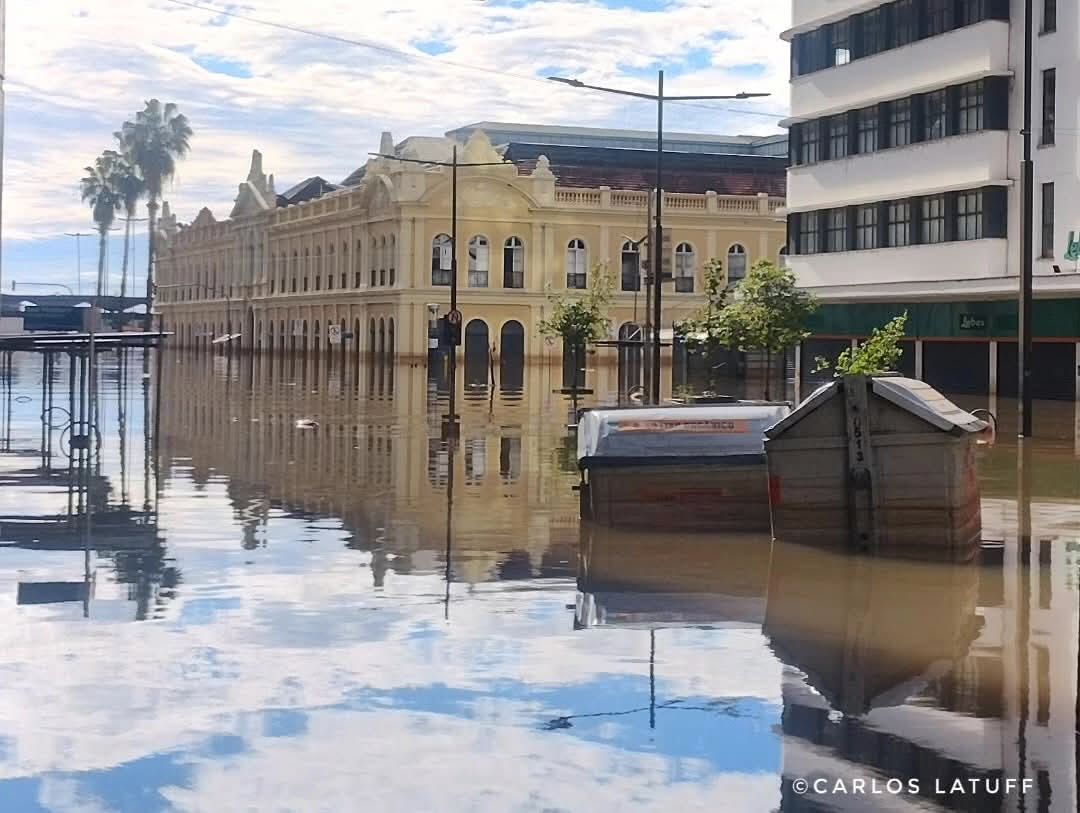
Downtown Porto Alegre, May 2024.
Naturally, this topic took up significant airtime on these stations. In the case of Rádio Independente in Lajeado—a municipality in a region hit by the recent high waters and severely battered by the 2024 flood—coverage was minute-by-minute. This highlights the fundamental role of radio—something I always like to emphasize—as it relays alerts, provides updates on river levels and flooded areas, and interviews authorities. I had visited Lajeado on June 12, 2024, to document the aftermath of the climate catastrophe that ravaged parts of the city, and I returned two years later, on July 23, 2026, to assess the damage from this latest flood. It’s a personal matter for me, as I was an eyewitness to this tragedy.
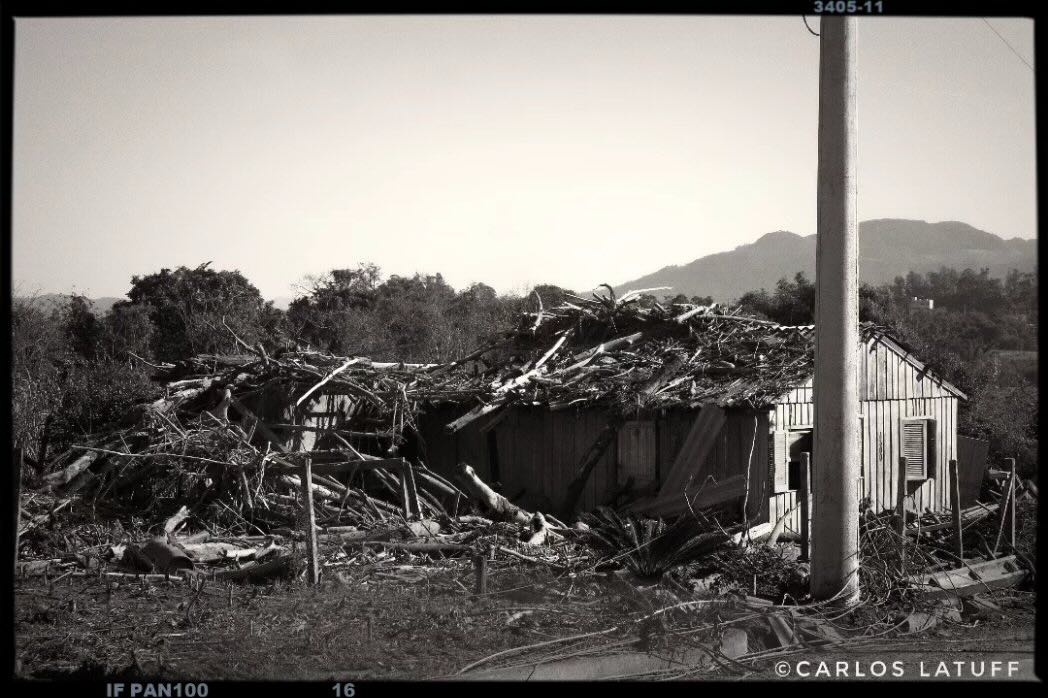
Lajeado, June 2024
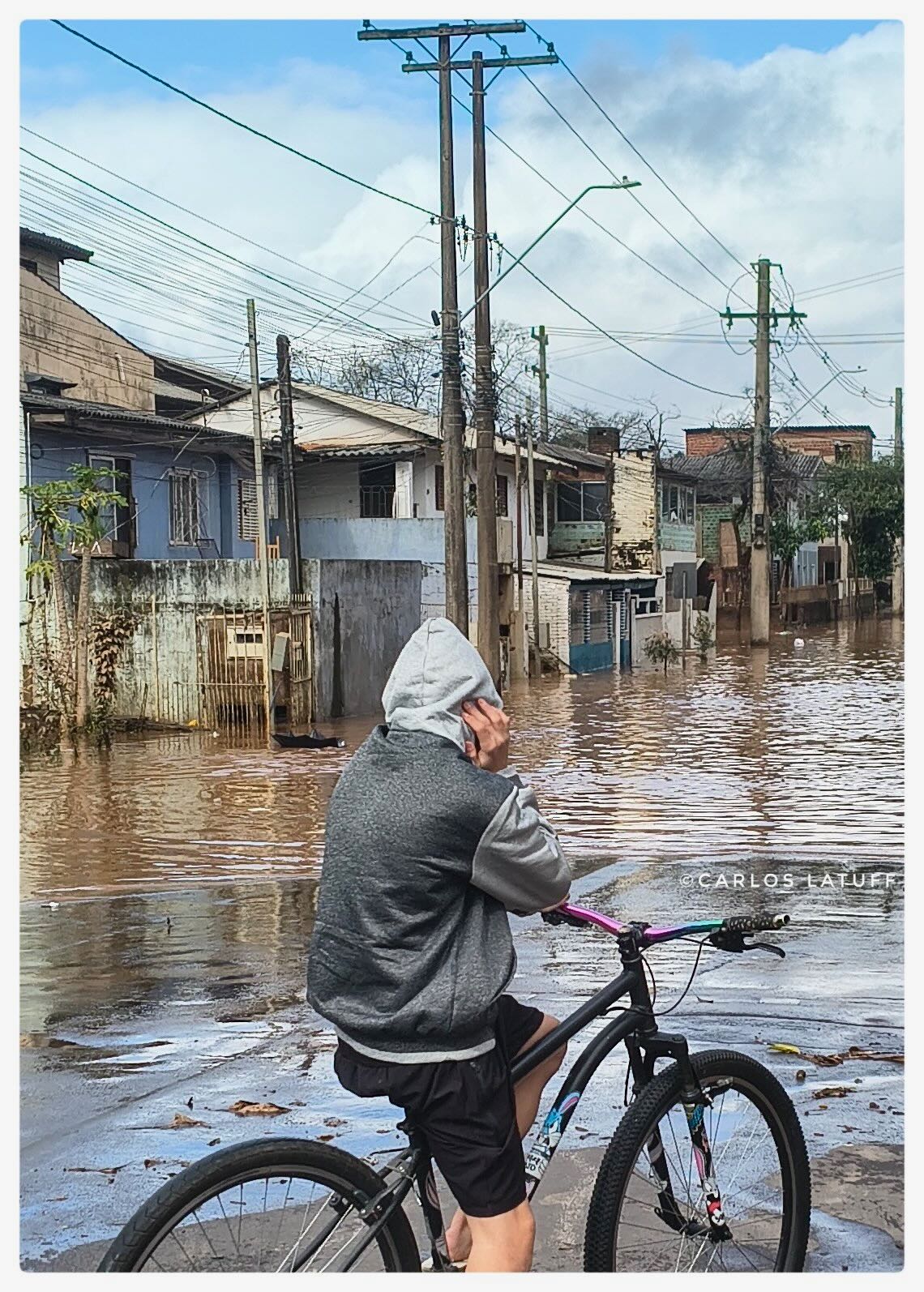
Lajeado, July 2026
Today, July 28, 2026, the broadcaster Tua Rádio reported on the damage caused by a storm that struck the municipality of Caxias do Sul, detailing the various public services disrupted by the loss of electricity, telephone lines, and the Internet. The presenter even took the time to explain the Beaufort scale, which was used to classify the storm winds that hit the area.
She also advised listeners: “Keep an ear on the radio.”
Once again, we arrive at a conclusion that all of us radio enthusiasts know by heart: everything fails… except the battery-powered radio! Power goes out, phone lines go down, and the Internet cuts out, but people can always rely on their battery-powered radios—something people in Spain, Portugal, and Chile also know well, having faced widespread blackouts in 2025.
The radio monitoring was conducted in Porto Alegre using two receivers: the Xhdata D808 and the Ecopower EP-F23B (the latter equipped with a flashlight and a solar panel).
That’s why I must insist: climate change is already knocking at our door. We need to prepare for the times ahead. And even though we are living through all the modern marvels of the 21st century—with AI and everything else—at the end of the day, what will save us is a battery-powered radio and a pack of candles.
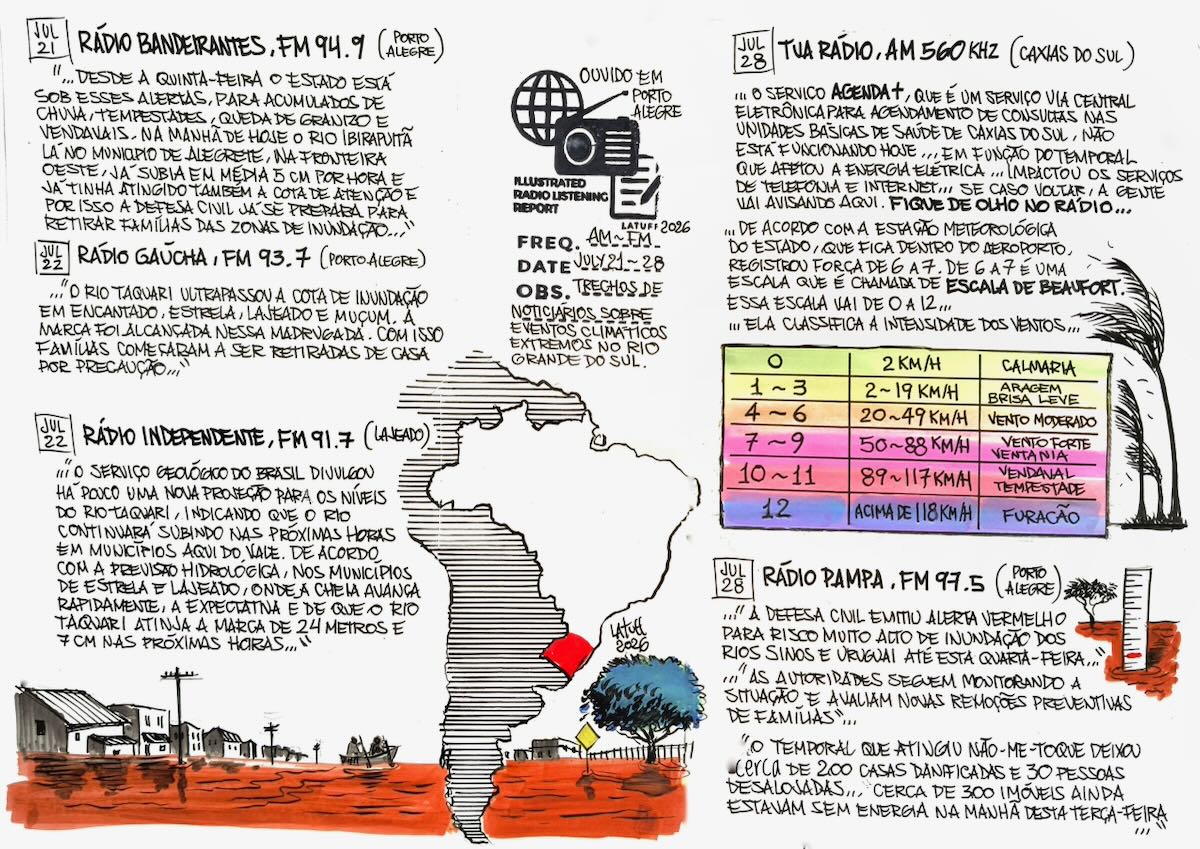
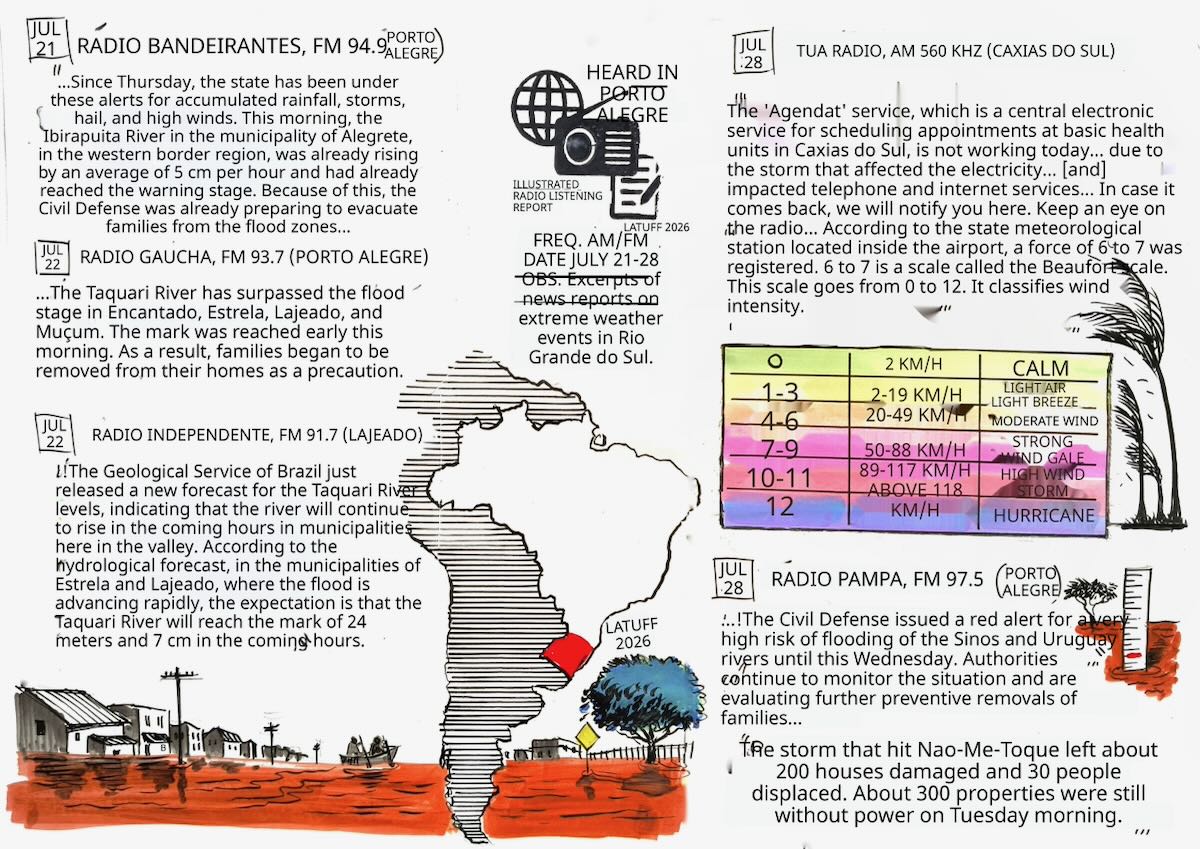
Here’s the illustrated radio listening report.
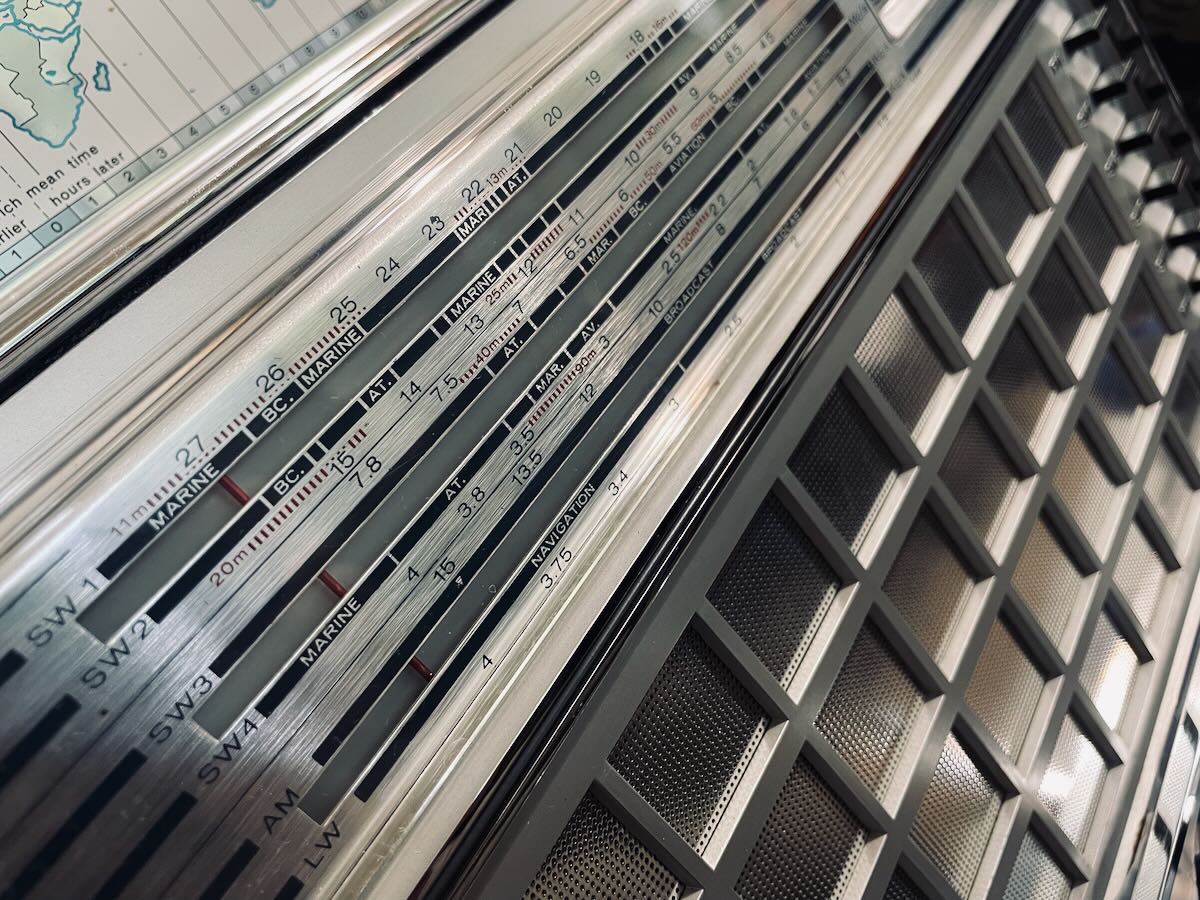 Many thanks to SWLing Post contributor Tracy Wood, who shares the following post from The Japan Times. The article highlights growing concerns over the future of Shiokaze (“Sea Breeze”), the shortwave radio service that broadcasts messages of hope and information to Japanese citizens believed to have been abducted by North Korea. As aging shortwave transmission facilities become increasingly difficult to maintain, supporters worry that one of the few remaining lifelines to the isolated nation could fall silent. Read the full article here: https://www.japantimes.co.jp/news/2026/07/27/japan/north-korea-abductees-radio/
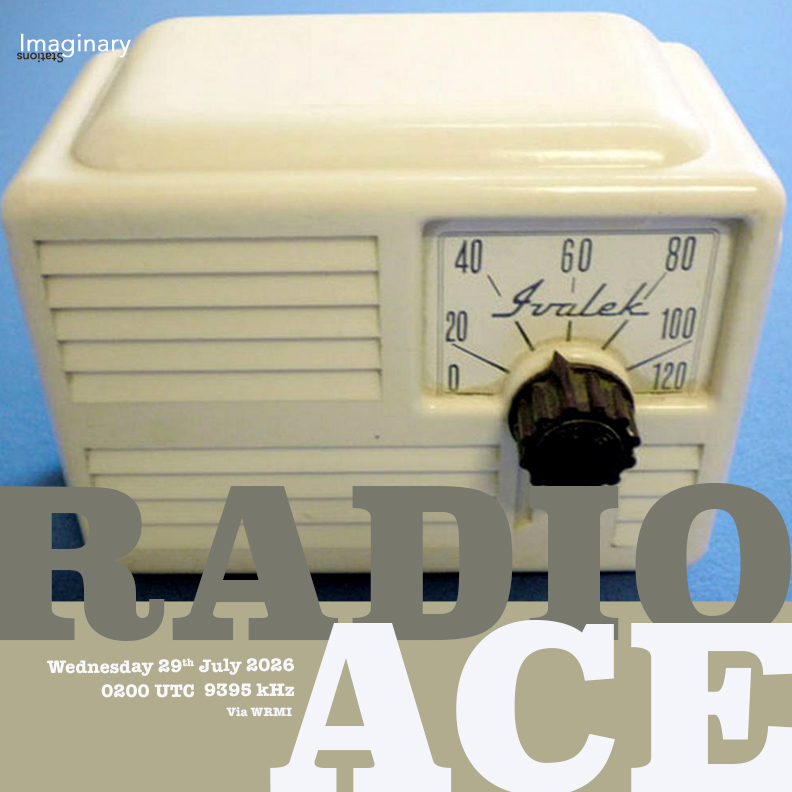
Hi to all SWLing Post community. Here’s the Imaginary Stations schedule for this week’s listening pleasure.
On Wednesday 29th July 2026, at 0200 hrs UTC on 9395 kHz on WRMI we have the return of Radio Ace. If you love all things radio related you’ll love Radio Ace and there maybe another appearance of the greatest DJ of all time (allegedly) Flash Frisbone, who knows? It’s worth tuning in and finding out.

Later, that day at 2000 hrs UTC on 3975 kHz/6160 kHz via Shortwave Gold, we bring you a repeat of last week’s special called Skybird Soul on Shortwave. Expect the best in soul and soul related tunes bounced off the ionosphere on a Wednesday night from DJ Frederick and One Deck Pete.
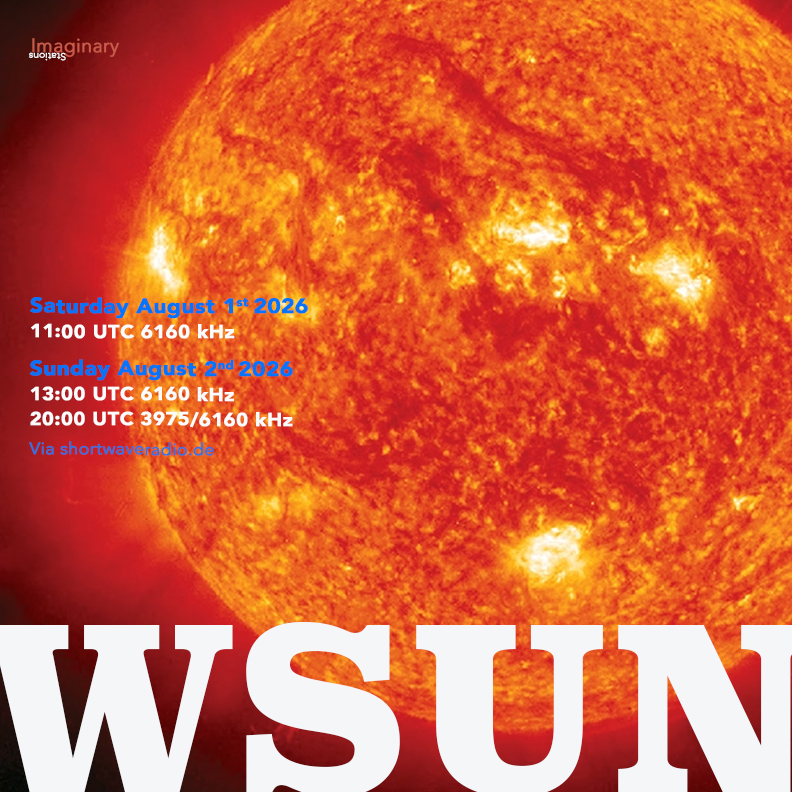
While on Saturday 1st August at 1100 hrs UTC on 6160 kHz and then again on Sunday 2nd August at 1300 hrs UTC on 6160 kHz and 2000 hrs UTC on 3975 kHz/6160 kHz, we have the debut of WSUN. This is a show all about the power of the Sun, that orangey/red thing that is located at the centre of our solar system. It’s going to be one hot, hot show with tunes about solar power, sundials, suntan lotion and anything that is related to that big ball of hot plasma. Tune in and enjoy the sound of the Sun!
For more information on all our shows, please write to us at [email protected] and check out our old shows at our Mixcloud page here.
FastRadioBurst23
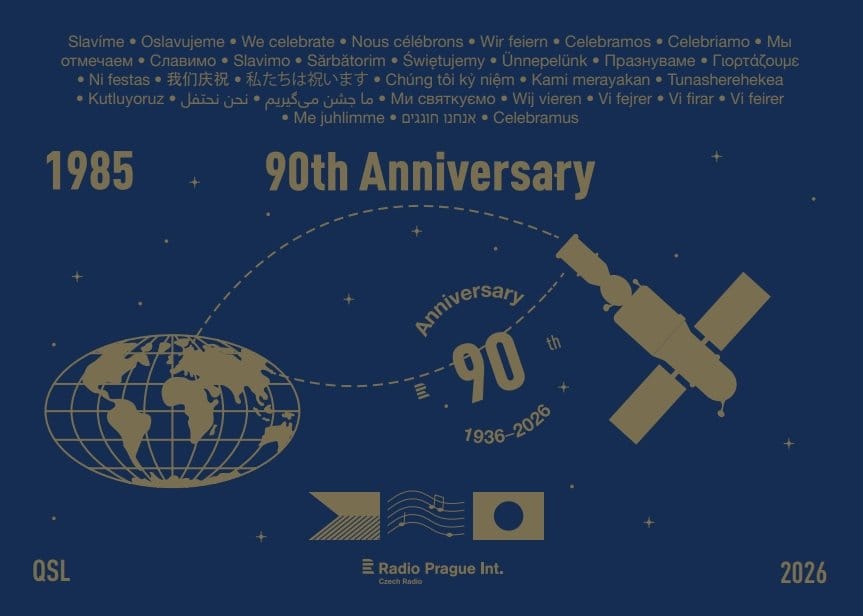 Many thanks to SWLing Post contributor David Iurescia for sharing this article from Radio Prague International, which explores how radio quickly became one of the most powerful tools of influence in the years following World War II, tracing the rise of Cold War broadcasting and the battle for listeners across Europe: https://english.radio.cz/captured-airwaves-how-postwar-broadcasting-became-propaganda-weapon-2-8889747
Many thanks to SWLing Post contributor and noted political cartoonist Carlos Latuff, who shares the following illustrated radio listening report.
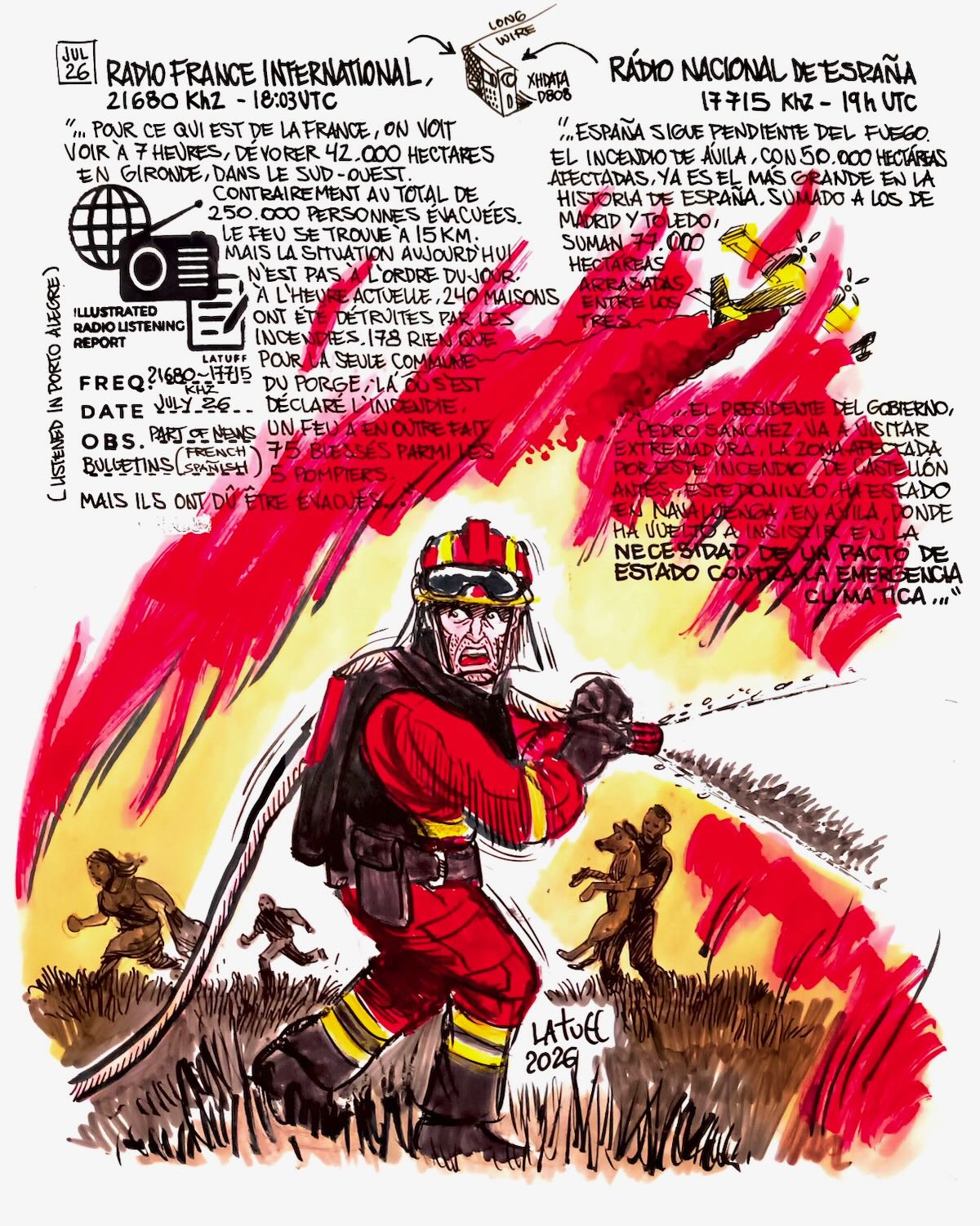
Carlos notes:
(Translated from the French)
“In France, as of 7 a.m., 42,000 hectares have been consumed in the Gironde region in the southwest, with a total of 250,000 people evacuated. The fire is located 15 kilometers away. So far, 240 houses have been destroyed—178 in the commune of Le Porge alone, where the blaze began. Additionally, five firefighters have been injured. A massive force is currently mobilized, including 2,500 firefighters, 1,500 military personnel, and 1,200 police officers and gendarmes; yet, they acknowledge their inability to control the fire’s immediate, erratic behavior.”
(Translated from the Spanish)
“Spain remains focused on the fires. The Ávila fire, with 50,000 hectares affected, is now the largest in Spain’s history. Added to those in Madrid and Toledo, a total of 77,000 hectares have been devastated across the three fires.”
“President Pedro Sánchez is set to visit Extremadura.
Earlier this Sunday, he visited Navaluenga, in Ávila—an area affected by the Castellón fire—
where he once again emphasized the need for a state pact to the climate emergency:
‘It is no longer just a matter of economic loss, but also of emotional distress
for many local residents who see their surroundings reduced to ash by these fires.
We must translate that obligation into a major state pact
to address the climate emergency’.”